
Watercolor journey with the course Roman Architecture by the Yale University.
I continue the paintings after the course Roman Architecture + the city of Rome with Yale’s course Roman Architecture https://www.coursera.org/learn/roman-architecture.
C. 4-6
This part of Roman Architecture‘s course was about Pompeii’s daily life in general, with many photo references. Pompeii’s streets look very modern with lots of bakeries, wine shops in the residential part of the city. For example, scientists discovered more than 30 bakeries. Few people in ancient Rome could afford to bake bread at home, so most bought it in the bakeries. Millstones for bake and for bay and ovens, that are part of bakeries look exactly as today’s bakeries in Italy. There were many fountains everywhere, for example a famous fountain with representations of the goddess Ceres.
I chose to paint the residential area with BIG pedestrian polygonal blocks of stones. It is a crossing part of the street. They are “talking” to us, telling their ancient stories about Pompeii’s daily life. If there was torrential rain, and the water piled up, people needed to cross the street without stepping in the water, but how? Romans were ingenious and concerned about their roads and pedestrians.
The stepping stones were placed in the streets so that people could cross the roads during and after the rain. Ancient people could easily walk around and were not afraid to wet their shoes and long dresses. As they continued gathering with friends and families, walking to the city’s centre or theatre, enjoying their daily life.
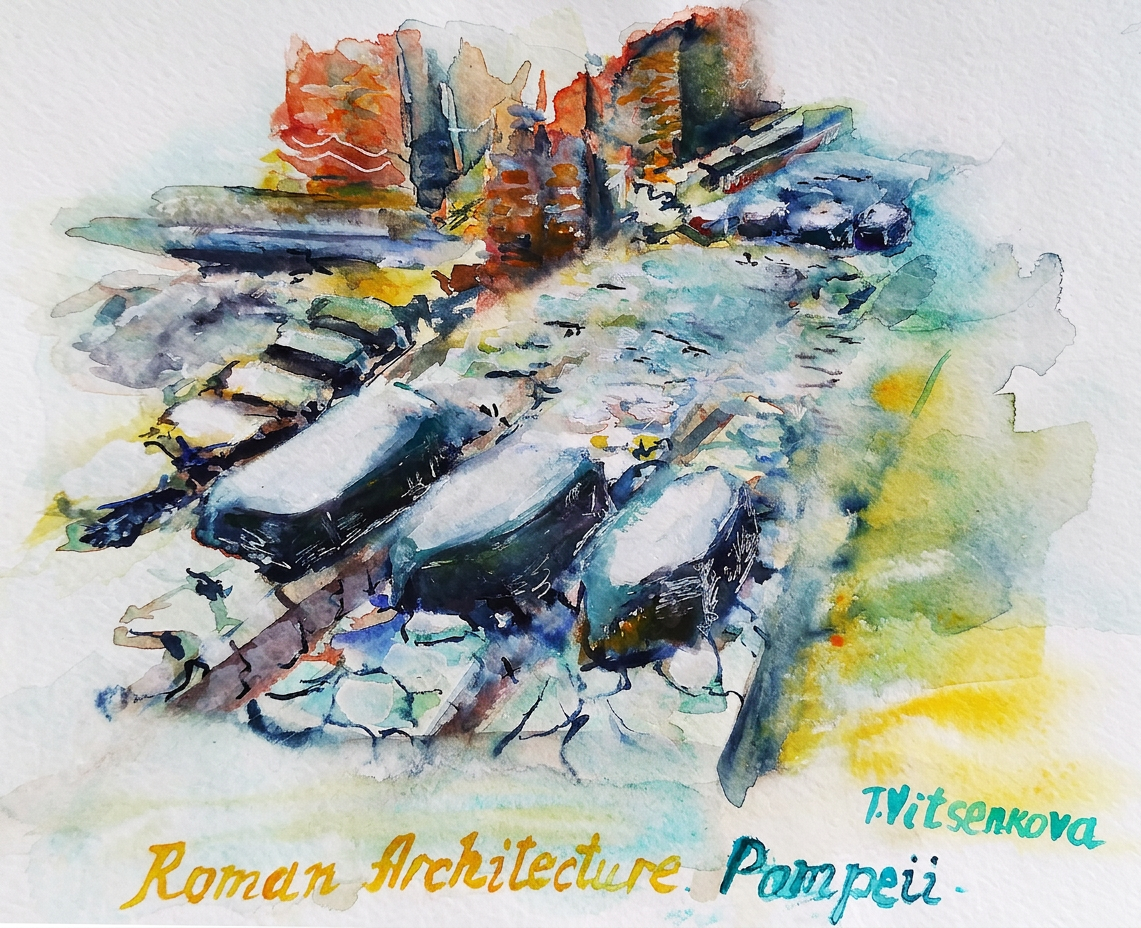
At the same time, these stepping stones were spaced apart far enough so that carts could still pass through the streets easily. The visible ruts that came from the horses and carts, between the stepping stones, show that they had to coordinate the wheels of the cart in such a way that they would span the stepping stones. Ancient Pompeii citizens could easily make their way across that stream by utilizing these stepping stones, “pondera”.
This was a genius architecture feat with responsible thinking thought about pedestrians. And even when my family walked in the city-museum of Pompeii with its astonishing view and a background of 2 majestic mountains- Vesuvius and Montezuma, we still found ourselves completely astounded by the stepping stones!
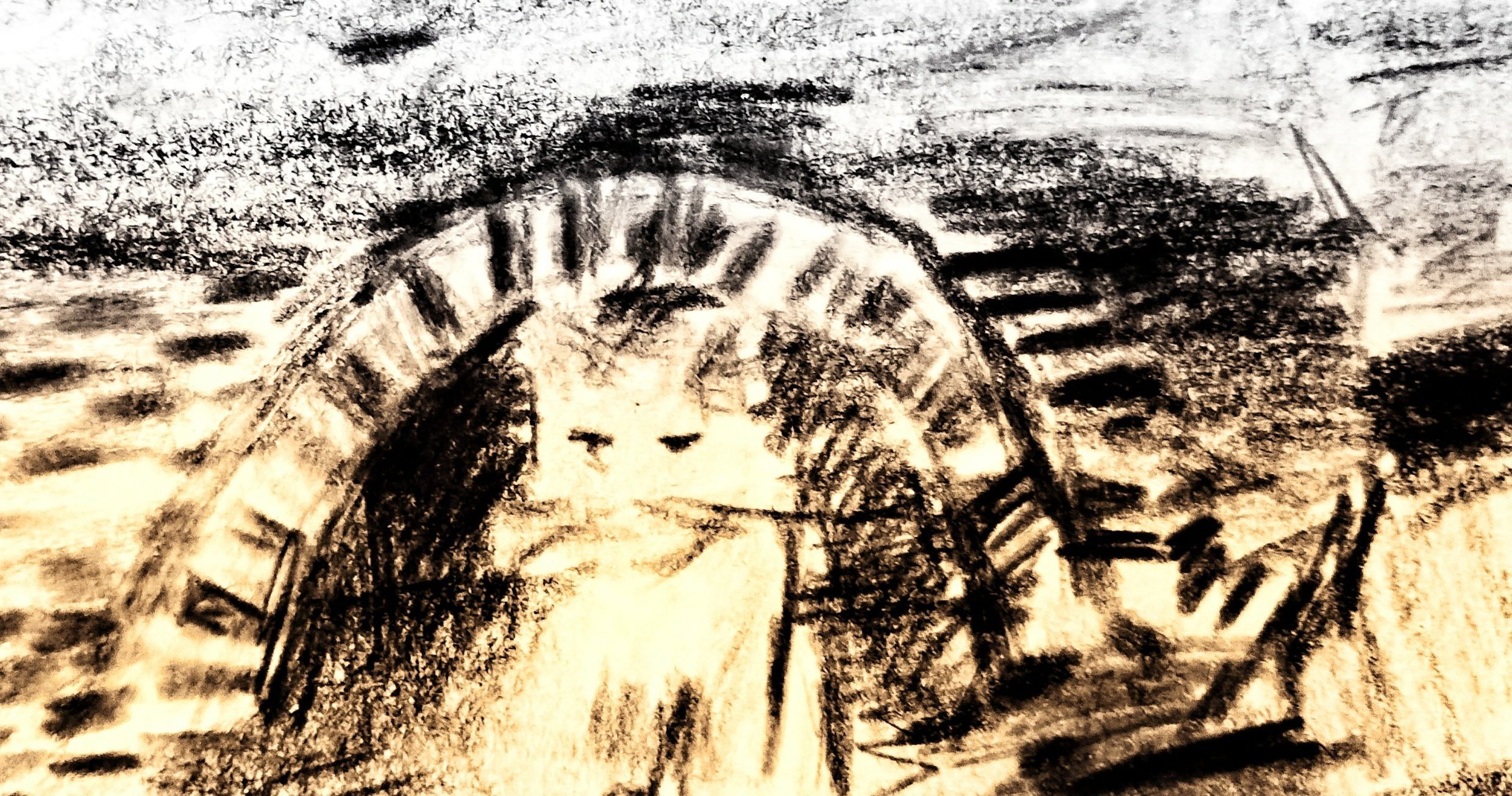
All roads lead to Rome – Alain de Lille
Bon voyage! Until the next travel :)
https://www.coursera.org/learn/roman-architecture/home/welcome
Painting – stones on the Streets of Pompeii -Daily Life, Roman Architecture
Year of construction- 79AD
Address: Pompeii
Tools used for my painting Watercolour raw sienna, permanent rose, Charvin vert imperial, Albert Durer and Faber Castell watercolour pencils. Paper Van Gogh National gallery watercolour album, 22×30 cm (9 ×12 in.)
The magic of the holidays is in the making!  Join me on this artistic adventure as I explore the captivating world of #TravelVibes #ArtAdventure
All paintings belong to the author. No image is to be copied without permission.
Make a one-time donation
Make a monthly donation
Make a yearly donation
Choose an amount
Or enter a custom amount
Your contribution is appreciated.
Your contribution is appreciated.
Your contribution is appreciated.


One thought on “4-6.Art and Travel. Daily Life and the Eruption of Vesuvius”