
Exploring Yale’s Course on Roman Architecture. Art Inspired by Ancient Rome
Let’s start my virtual journey Art + Roman Architecture + the city of Rome with Yale’s course Roman Architecture. Professor of History of Art and Classics Diana E.E. Kleiner Dunham
Why did I decide to dive headfirst into the world of Roman architecture
As I start the Yale’s course on Roman Architecture, I’m reminded of my childhood dreams of becoming an architect. Life has taken me on a different path, but it’s never too late to pursue our passions.
To share this journey, I’ll be conducting research on each topic we cover and posting my findings here. Plus, as an artist, I’ll be creating a watercolor painting inspired by each lecture—combining my love for art and history.
Well, life is funny thing. You are dreaming about one thing when you are a child, and doing another thing when you are an adult. It is never so late to start to learn our dreamy course.
My visual path to learn Roman Architecture course
As a student, I will share my knowledge. I will conduct research after each topic.And as an artist, I will add one watercolor freely painting for each lecture
How I do my paintings for the course? There is one cheerful technique called from middle tone that I have learned in my art school many years ago. I will give the link to school’s website at the end of this post.
Middle tone watercolor technique
This Italian painting technique is called the middle tone. Basically, you use two or three watercolor paints without worrying too much. The colors blend freely, creating a middle tone. You just add light highlights and dark shadows. And voila, you can paint playfully and fearlessly with this technique!
Have you embraced middle-tone watercolor technique in your artworks? Do you feel that exhilarating spark of joy? Please, I invite you to share your experience in the comments below. I would be thrilled to hear your inspiring story!
So, let’s start!
Introduction. Roman Urbanism. 1-1
Rome, Servian Walls, Roman Architecture. Year of construction- 3 century B.C.
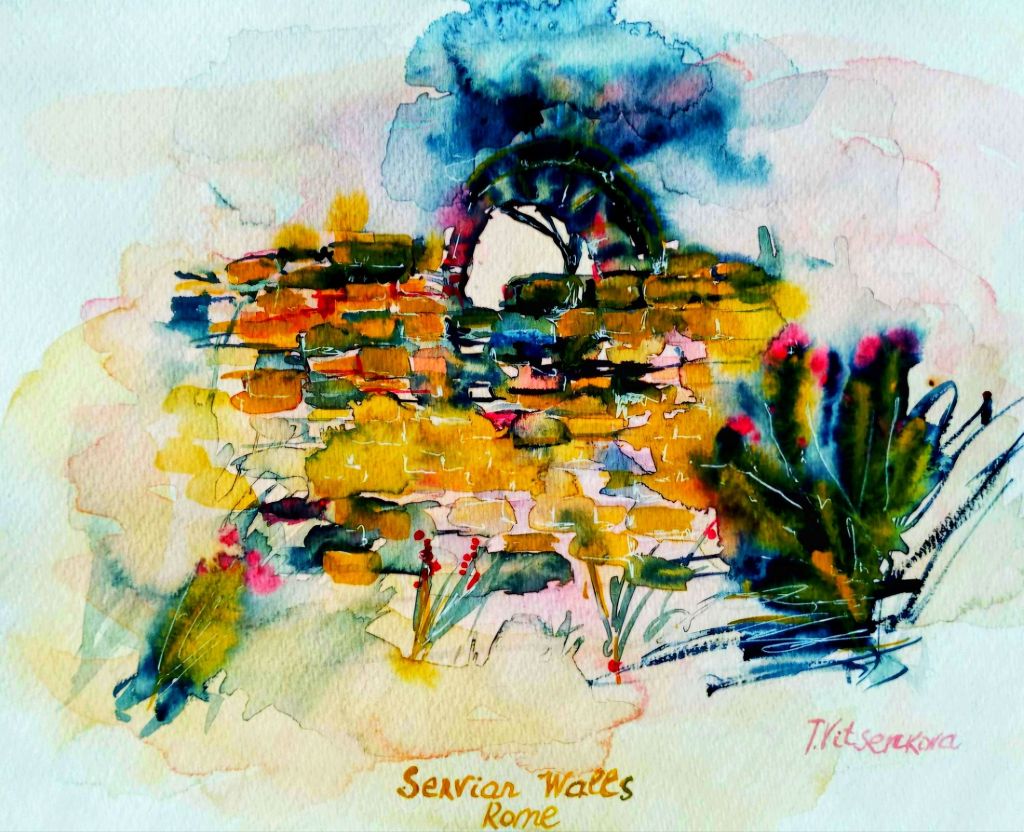
During the first lecture of Roman Architecture, the professor taught us about the Servian Walls. They are an incredible example of ancient Roman ingenuity.
The Servian Walls stand as a magnificent testament to ancient Roman ingenuity and determination! This formidable barrier rose proudly around the legendary Seven Hills of the republican city. It was constructed in the wake of the catastrophic Sack of Rome in the 4th century B.C., a period when the very soul of the city cried out for protection and resilience. These walls embody the spirit of a civilization striving to safeguard its legacy and embrace its future with unwavering strength!
My first painting celebrates the Servian Wall, the very first ancient Roman wall! This artwork pays tribute to this remarkable monument of ancient Roman architecture, highlighting its significance and enduring beauty.
The early period of Roman architecture
In the early period of Roman architecture, builders simply stacked stone blocks. These blocks were piled one on top of the other to form the wall.
Rome grew over time. In the first lecture I have learned that in the late third century AD, the emperor Aurelian reigned. During this time, the impressive set of the Aurelian Walls was built. These walls were constructed to protect the city of Rome from external threats.
These fortifications represented a significant architectural achievement of their time. They served as a symbol of the resilience and enduring power of the Roman Empire. They helped secure the city against invasions. They provided a stronghold for its citizens.
The walls spanned approximately 19 kilometers
Romans were constructed using a combination of brick and stone. This showcases the engineering prowess of ancient Rome. It also contributed to the city’s defensive capabilities for centuries to come.
A new technology is concrete revolutionized Roman architecture and concrete faced with brick. We can still see some parts of the two ancient walls in Rome.
I added to this post a watercolor pencil- sketch with a cat that enjoying a view of Roman architecture, just for fun:)

Termini station in Rome and nearby hidden gem
We can still see the very wide section of the Servian Walls near Rome’s train station Stazione Termini station.
I must admit, I’ve wandered past a section of the fortress wall near the station in Rome many times. It’s like my own version of a tourist treadmill! Architecture is not just about buildings; it’s about shaping experiences.
And let me tell you, that Esquiline Gate of the Servian Wall? It’s basically the VIP entrance to my accidental monument-hopping tour!
“All roads lead to Rome” Alain de Lille
I completely missed this epic piece of Roman architecture in history. I just admired the architectural monuments during my multiple trips to Rome. I am gaining new knowledge with this course.
On my next trip, I will definitely return to the remains of the fortress wall. I’ll also be making a grand entrance at the gates of the Eternal City. Hopefully, they’ll have a welcome sign and not just a “tourists beware” notice!
This is what I have learned in the first lecture in this course. It is a lot of new information for me. I love Rome and its architecture.
Join me as I uncover the beauty of Roman architecture, and let’s explore this amazing world together!
Bon voyage! Until the next travel:)
Address: Piazzale dei Cinquecento, Rome
The magic of the holidays is in the making!  Join me on this artistic adventure as I explore the captivating world of #TravelVibes #ArtAdventure
All paintings belong to the author. No image is to be copied without permission.
Make a one-time donation
Make a monthly donation
Make a yearly donation
Choose an amount
Or enter a custom amount
Your contribution is appreciated.
Your contribution is appreciated.
Your contribution is appreciated.


Yale University Roman Architecture online course https://www.coursera.org/learn/roman-architecture/home/welcome
art online school https://mogut-vse.ru/
Tools used for my painting are next:
Watercolour Windsor Newton Gamboge , Alison, indigo , Derwent, Albert Durer and Faber Castell Watercolour pencils. Paper Fluid 100, cold press Watercolour albums, 22×30 cm (9 ×12 in.)
 Art and travel club
I loved doing that course.
LikeLiked by 1 person
Thank you! Learning is a journey, and I am looking forward for it:) When did you take the course?
LikeLiked by 1 person
I took it during the pandemic, while doing research for one of my books. I’m still absurdly proud of my capstone project, which I did without benefit of CAD software (or much artistic talent to speak of, LOL).
LikeLiked by 1 person